
Audiences today seek more than passive viewing. Both adults exploring cultural heritage and kindergarten children want to actively engage with immersive art experiences.
To make this happen, teams like Lumotion Studio bring together technology, hardware, and storytelling. They turn regular spaces into interactive environments that people can explore.
To give you an idea of how this works in practice, we will break down the process using two of our real-world projects as examples: a large cultural digital museum and an interactive children’s attraction.
Case study 1: The Interactive Museum of Tabuk (cultural edutainment)
Developed in collaboration with investment company Samaya for the Saudi Arabian Ministry of Tourism and National Heritage. This 1,200 m² digital museum is a signature project that beautifully brings the history of Tabuk to life.
Background: Overview of the Situation
In Tabuk, the big challenge was figuring out how to make ancient history feel interesting and meaningful for people today. That meant finding ways to get families, students, and visitors excited about the past, and at the same time, helping the city stand out and attract more tourists.
Requirement: Project Needs
The client’s goal was to shift the visitor experience from passive reading to active participation. The idea was to create long-lasting interactive museum exhibits. With the help of using cutting-edge tech that’s usually used in temporary festival installations or immersive art exhibitions. Then, adapt them to permanent installations, which could work flawlessly year after year.
The solution: what we did
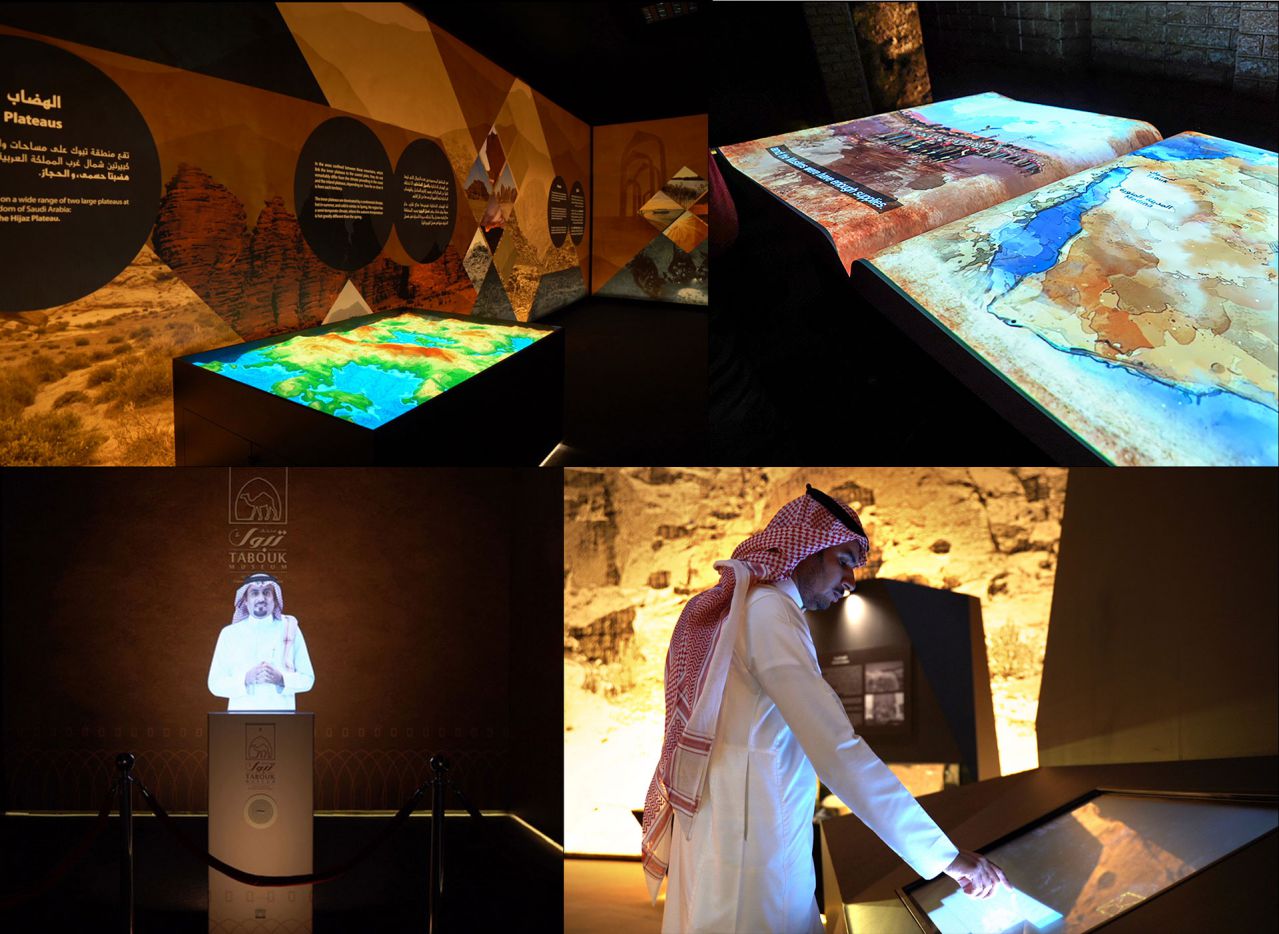
Lumotion Studio has developed an interactive environment in which technology is the main narrator. This was achieved through the implementation of several key installations:
Interactive book:
Visitors can flip through virtual pages, revealing animated cultural stories and visual effects in real time. Using gesture recognition, visitors wave their hands.
Multimedia touch wall:
When you touch the wall, it shows historical illustrations and interactive visuals. The whole thing uses a big digital canvas with high-brightness projectors, so everything looks bright and clear.
Interactive table:
Groups can use this table to look at 3D models and maps together. The display is high-resolution and built for hands-on, collaborative learning.
Interactive sandbox:
Here, you can shape mountains and valleys with your hands. The system uses 3D mapping and a depth sensor to project contour lines and water effects right as you move the sand.
Interactive information stand:
A multilingual, intuitive digital guide that helps visitors navigate the museum’s immersive areas.
Results: Achievements
The interactive museum has been open for more than two years now. It turned a traditional archive into a digital museum that mixes ancient culture with new technology for entertainment and learning.
Case study 2: Mini Midgard (interactive children’s attractions)
Museums are focused on cultural heritage, while kids’ places need a new way to get kids involved. Lumotion Studio is all about turning educational spaces into immersive digital environments, as you can see from our redesign of the Mini Midgard kindergarten.
The background: what was the situation?
We noticed that children need more than just static toys during the implementation of the Mini Midgard project. Traditional playrooms often lack a bright, stimulating environment. This keeps modern children interested and active.
The requirement: what was needed?
The venue needed an interactive game room that promotes creativity, coordination, and physical activity without taking up the limited physical space of the room. The solutions had to be safe, contactless, hygienic, and highly responsive.
The solution: what we did
We have developed and installed a flawless interactive projection installation, using the most advanced interactive gaming system. The hardware includes: high-precision sensors, high-brightness projectors, and real-time data processing units. There are three main features:
First – Interactive avatar drawings
With this feature, kids can see their drawings come to life on the screen. It gives them a fun way to be creative.
Second – Interactive running zone
Here, motion tracking lets kids run and play on the floor. It helps them work on their coordination while having fun.
Third – Interactive target area
In this area, kids can throw balls at digital targets. It’s a safe way for them to play and stay active.
The result: what we achieved
We turned regular walls and floors into interactive play areas. Our projection mapping games mix physical activity with digital learning. Because we use the surfaces that are already there, the space stays open and easy to move around in. The games can be updated every year, so there’s always something new to try.
Ready to transform your space?
Lumotion Studio handles everything, from the technical setup to the final details. We work on all kinds of projects, from big interactive museums to playgrounds for preschools, kindergartens, and indoor parks.
Each projection game we make is designed to be fun and educational at the same time.
Contact Lumotion Studio today for a free consultation. We look forward to bringing interactive experiences to your facility.